Western vs Vedic Astrology: How to Find Your Real Zodiac Sign
Western and Vedic astrology place you in different zodiac signs. Learn why the 23-degree gap exists and how to find which sign actually fits your life.
🔮 Get Your Free Multi-Fortune Analysis — 5 Ancient Systems, 1 Unified Reading → MultiFortune.xyz
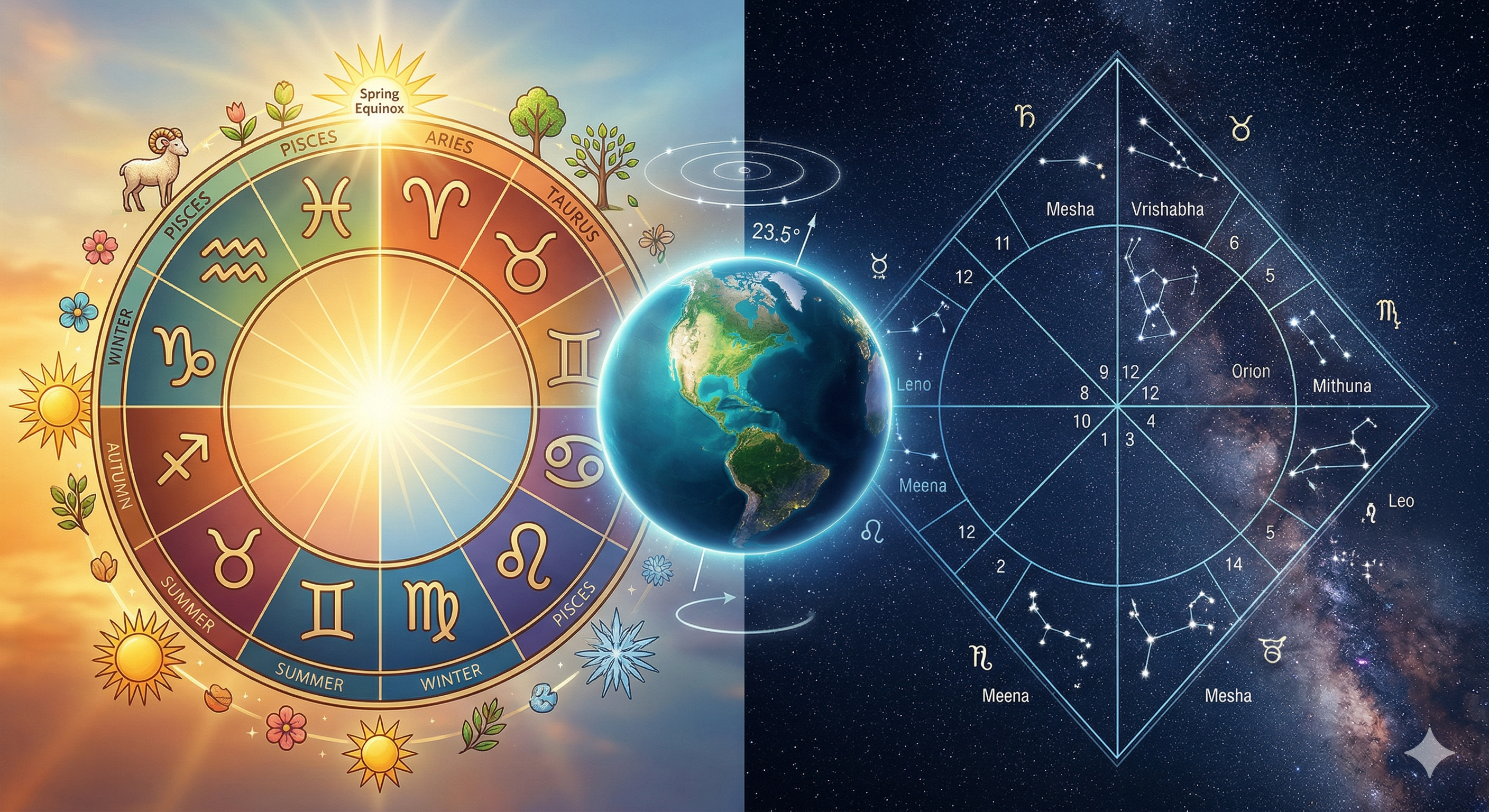
There's roughly a 1-in-4 chance you've been reading the wrong horoscope your entire life. The zodiac sign you've identified with since childhood — the one on your coffee mug, your dating profile, your group chat nickname — may not be the sign that ancient astronomers would assign you.
The reason is a 23-degree gap between two legitimate systems of astrology, and neither one is "wrong." But understanding this gap changes how you read every horoscope, forecast, and birth chart from this point forward.
🔮 Get Your Free Multi-Fortune Analysis — 5 Ancient Systems, 1 Unified Reading → MultiFortune.xyz
The 23-Degree Problem Nobody Explains
Western astrology uses the tropical zodiac — signs are anchored to the seasons. Aries begins at the spring equinox, every year, no matter where the actual constellation of Aries sits in the sky.
Vedic astrology (Jyotish) uses the sidereal zodiac — signs are anchored to the fixed stars. And here's the problem: the Earth wobbles. A slow axial tilt called precession shifts the seasonal markers against the star backdrop by about 1 degree every 72 years.
Over two millennia, that wobble has accumulated to roughly 23-24 degrees. So right now, on April 14, 2026, Western astrology places the Sun at 24° Aries. Vedic astrology? It places the Sun at approximately 1° Aries — nearly an entire sign behind. If you were born in the first three weeks of any Western sign, Jyotish likely assigns you to the previous sign entirely.
That "proud Leo" might be a Cancer in Jyotish. That "analytical Virgo" might actually carry Leo energy in the Vedic framework.
How to Find Your Real Vedic Sign (5-Minute Check)
You don't need a Jyotish astrologer for the first pass. Here's what to do right now:
- Step 1: Note your Western Sun sign and the degree (any free birth chart calculator gives this — you need your birth time).
- Step 2: Subtract 23 degrees from your Sun's position. Example: Sun at 15° Gemini → subtract 23° → approximately 22° Taurus.
- Step 3: If the subtraction pushes you into the previous sign, that's your Vedic Sun sign. If it doesn't (you're late in your Western sign, past ~24°), you stay in the same sign in both systems.
- Step 4: Read horoscopes for BOTH signs for two weeks. Track which one describes your actual lived experience more accurately.
Step 4 is the one most astrology sites skip — and it's the only one that matters. The math tells you where the planets sit. Only your experience tells you which framework resonates.
What Each System Actually Measures
Here's the insight that resolves the apparent contradiction: these two systems aren't competing answers to the same question. They're answering different questions entirely.
Western tropical astrology maps your relationship to earthly cycles — seasons, light patterns, the rhythm of the year where you were born. It excels at psychological profiling. When a Western chart says you're a Scorpio, it's describing how seasonal energies shaped your temperament.
Vedic sidereal astrology maps your relationship to cosmic positioning — where the actual stars were. Jyotish places heavy emphasis on predictive timing through its dasha system, a planetary period framework that Western astrology doesn't use at all. When a Vedic chart says you're a Libra, it's describing the stellar frequencies present at your birth and forecasting concrete life events.
Today's Mars-Saturn conjunction at 3°-7° Aries hits differently in each system. Western astrologers read this as early Aries energy — impulsive, initiating, fiery. Vedic astrologers see it closer to late Pisces territory — dissolving, spiritual, surrendering. Same sky. Different maps. Both valid for their intended purpose.
The Cross-System Pattern Most Astrologers Miss
After years of analyzing charts through multiple traditions — including Saju (Korean Four Pillars) and Zi Wei Dou Shu — one pattern stands out consistently: people who feel "mismatched" with their Western sign almost always find their Vedic sign describes their career and financial patterns more accurately, while their Western sign better captures their emotional and relational style.
Consider today's energy as a test case. The Saju day pillar reads 戊午 (Wu-Wu) — Earth sitting on Fire, with Fire dominating the entire chart (5 Fire elements vs. 1 Water). Western astrology shows Venus sextile Jupiter with a tight 0.8° orb — an aspect of expansion in love and money. The Vedic reading of that same Venus-Jupiter contact emphasizes duty and dharmic partnership over romantic chemistry.
None of these readings cancel each other. They're layers. And the people who get the most from astrology are the ones reading all the layers simultaneously.
Your Next Step
Do the 23-degree subtraction on your chart today. Then spend the next two weeks — through this waning crescent moon and into the fresh new moon cycle — reading horoscopes for both your Western and Vedic signs. Keep a simple note on your phone: which daily forecast matched reality? By the end of those two weeks, you won't wonder which sign is "real." You'll know which system to consult for which type of question.
FAQ
Is my Vedic zodiac sign more accurate than my Western one?
Neither is universally more accurate — they measure different things. Vedic astrology often predicts external events and timing better, while Western astrology tends to describe personality and emotional patterns with more precision. Use both for a complete picture.
Can my zodiac sign be the same in Western and Vedic astrology?
Yes. If your Sun is positioned past roughly 24° of your Western sign, the 23-degree sidereal correction won't push you into the previous sign, and both systems will agree on your Sun sign.
🔮 Get Your Free Multi-Fortune Analysis — 5 Ancient Systems, 1 Unified Reading → MultiFortune.xyz
🔮 Get Your Free Multi-Fortune Analysis — 5 Ancient Systems, 1 Unified Reading → MultiFortune.xyz
