Celtic Cross Tarot: Read All 10 Cards as One Story
🔮 Get Your Free Multi-Fortune Analysis — 5 Ancient Systems, 1 Unified Reading → MultiFortune.xyz
🔮 Get Your Free Multi-Fortune Analysis — 5 Ancient Systems, 1 Unified Reading → MultiFortune.xyz
You've shuffled three times. Ten cards are face-down on the table. And you're staring at them wondering: where do I even start?
Most Celtic Cross guides walk you through positions 1 through 10 in order, leaving you with a list of meanings that don't connect into a story. That's not a reading. That's ten fortune cookies laid in a cross shape.
By the end of this guide, you'll know how to lay out, sequence, and interpret the Celtic Cross as a single unified narrative — including the one reading mistake that makes even experienced readers miss the most important cards.
Why the Celtic Cross Outlasted Every Other Spread
The Celtic Cross isn't the most used spread in tarot because it's traditional. It's used because it answers what readers actually want to know: where I am, what's working against me, where this is headed, and what I'm not seeing.
Other spreads answer one question. The Celtic Cross answers the question behind the question.
The spread divides into two sections: the Cross (positions 1–6), which shows the landscape of your situation, and the Staff (positions 7–10), which resolves it. Most readers spend 80% of their time on the Cross and rush through the Staff. That's backwards — the Staff is where the reading lands.
The 10 Positions: What Each One Is Actually Asking
- Position 1 — The Heart: Your current situation as it actually is — not as you wish it were.
- Position 2 — The Cross: The energy interacting with your situation. Not necessarily an obstacle — it can be an amplifier, a complication, or an emotion you're projecting.
- Position 3 — The Root: The unconscious foundation driving this situation beneath your awareness.
- Position 4 — The Past: Energy that was active but is now leaving the picture.
- Position 5 — The Crown: The best possible outcome you're aiming toward — or what you think you want.
- Position 6 — The Near Future: Where this is heading if the current trajectory holds.
- Position 7 — Your Role: How you're showing up — your attitude, your pattern.
- Position 8 — External Environment: What others see, or how outside forces are shaping things.
- Position 9 — Hopes & Fears: Usually both at once — the thing you most want is often exactly what you most fear losing.
- Position 10 — The Outcome: The likely resolution given everything else in the spread.
The Reading Sequence Nobody Teaches (But Changes Everything)
Here's the insight that separates a useful Celtic Cross from a confusing one: don't read it in order from 1 to 10.
Reading sequentially is like reading a novel without understanding its structure. Instead, use this sequence:
- Start with Position 10 (Outcome). Know where the spread ends. This anchors everything else.
- Read Positions 1 and 2 together. They're in dialogue — one card doesn't make sense without the other.
- Read the vertical axis: 3 (Root) → 5 (Crown). The hidden narrative: unconscious drive reaching toward a conscious goal.
- Read the horizontal axis: 4 (Past) → 6 (Future). The timeline — where you've been, where momentum is carrying you.
- Read the Staff (7–10) as a story arc. Position 7 is the character. Position 8 is the setting. Position 9 is the conflict. Position 10 is the resolution.
When you read this way, the spread stops being ten separate messages and becomes one coherent story.
The Most Misread Position: What the Crossing Card Really Means
Position 2 is called "what crosses you" — and most guides stop there. But the crossing card isn't simply an obstacle. It's the energy currently in conversation with your central situation. Sometimes it blocks. Sometimes it's a resource you're ignoring. Sometimes it's an emotion you're projecting onto a situation that doesn't actually contain it.
The key question for Position 2 isn't "what's blocking me?" — it's "what energy is my situation tangled with right now?"
With Moon square Saturn sitting at a tight 0.6° orb today, many readers will feel that crossing energy as something heavy and restrictive. If you pull a difficult card in Position 2 this week, don't assume permanent opposition — Saturn's squares often reveal the structure you need, not just the limitation you feel.
Do This Reading Right Now (Copy-Paste Ready Layout)
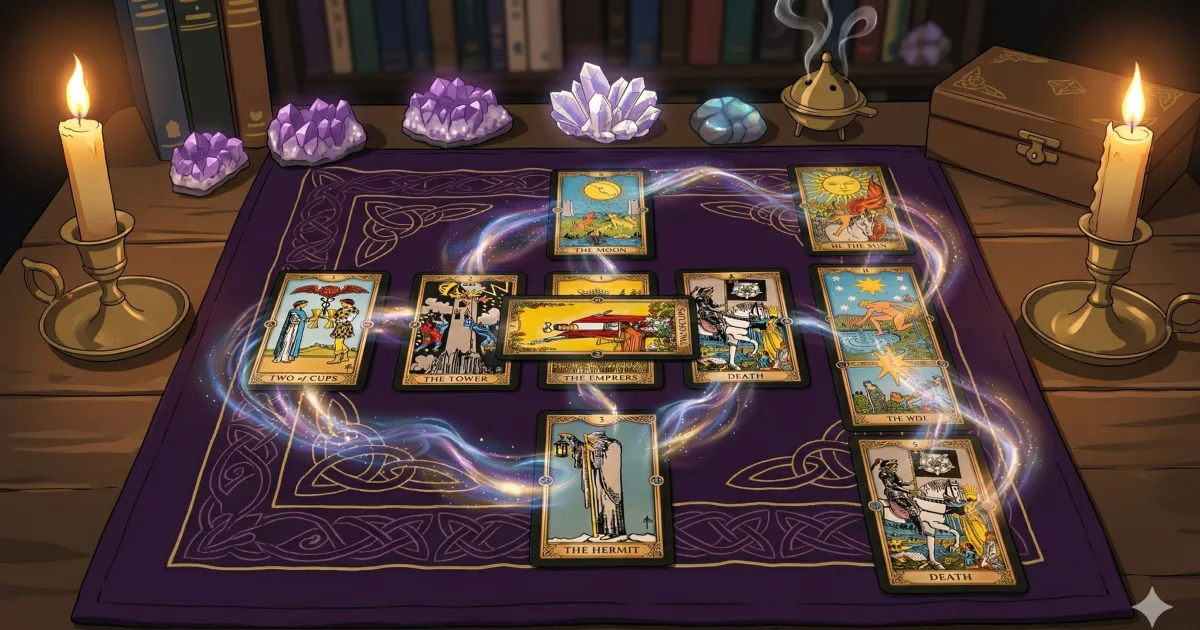
Physical layout (place cards in this order):
[5 — Crown]
[4 — Past]   [2 sideways over 1]   [6 — Future]
[3 — Root]

[7]   [8]   [9]   [10 — Staff, bottom to top]
Your focus question before shuffling:
"Show me the full truth of [situation] — what's present, what's hidden, and where this leads."
After laying all 10 cards, check these three things first:
- Which suit appears most? More than 4 of one suit means that element dominates the situation (Cups = emotion, Swords = conflict, Pentacles = material, Wands = action).
- Major or Minor Arcana heavy? Majors mean larger forces are in motion. Minors mean your daily choices carry more weight than fate right now.
- Does Position 10 feel like a continuation of Position 5, or a surprise? A surprise outcome means something in your current approach needs to shift before the Crown becomes reachable.
The Hidden Architecture: Why This Spread Goes Deeper Than It Looks
Here's a connection that doesn't appear in standard Celtic Cross guides: the ten positions map almost exactly onto the ten Sefirot of the Kabbalistic Tree of Life. Position 1 (the present) corresponds to Malkuth — manifestation, the physical world. Position 5 (the crown) corresponds to Kether — pure potential, divine will. The Staff runs along the central pillar from Yesod (foundation) to Kether.
This isn't just an interesting footnote. It means the Celtic Cross was designed — consciously or not — to hold a complete cosmological framework. When a card in a difficult position resists interpretation, asking "where does this energy sit on the Tree?" can unlock a layer that tarot symbolism alone won't reach.
There's a parallel in Saju (Korean Four Pillars): the four pillars of Year, Month, Day, and Hour create a similar cross-axis — past lineage, current environment, personal self, and hidden potential. Both systems are solving the same architectural problem: how do you hold time, environment, and inner reality in a single readable frame? The Celtic Cross and the Saju chart are structural cousins, separated by tradition but answering the same human question.
The Staff Section: Where Your Reading Actually Resolves
Positions 7–10 are the most skipped — and the most important. Think of them as the answer to the question the Cross raised but couldn't settle on its own.
Position 7 (Your Role) is often the most honest card in the spread. It shows you something you're doing — a pattern, an attitude — that you'd rather look past. Don't.
Position 9 (Hopes & Fears) is where readers tie themselves in knots: "Does this mean I hope for it or fear it?" Almost always, both. The thing you most want is also the thing you're most afraid will disappear. Sitting with that paradox — rather than trying to split the card into one or the other — is where genuine insight lives.
Position 10 doesn't predict fate. It shows the most likely resolution given the current pattern. If you don't like what you see there, look at Position 7 — that's where the leverage point lives.
Your Next Step
Pull out your deck. Choose one situation that's been circling in your mind for more than a week. Use the layout and reading sequence above. Don't force an interpretation on Position 2 — sit with "what energy is this?" before deciding whether it's helpful or not. Let the Staff give you the resolution the Cross sets up.
If you want to cross-check what the cards are showing you with numerology, astrology, or your Saju chart, a multi-system reading can confirm patterns that tarot alone sometimes leaves ambiguous.
🔮 Get Your Free Multi-Fortune Analysis — 5 Ancient Systems, 1 Unified Reading → MultiFortune.xyz
Frequently Asked Questions
Can you use any tarot deck for a Celtic Cross reading?
Yes — the Celtic Cross works with any 78-card tarot deck. Rider-Waite-Smith based decks are easiest for beginners because the numbered minor arcana cards carry illustrated scenes, but the spread structure works with any deck style.
How often should you repeat a Celtic Cross on the same question?
Once per situation is the rule most experienced readers follow. Repeating the spread within days on the same question reflects your anxiety back at you, not new insight — the cards will mirror the agitation, not resolve it.
What if the Outcome card (Position 10) doesn't match the Crown (Position 5)?
That gap is the reading's core message: what you're aiming for and where you're actually headed are not aligned. Look at Position 7 (Your Role) — that card almost always holds the reason for the divergence, and the adjustment you need to make.