AI Fortune Telling 2026: 5 Ways Tech Upgrades Ancient Wisdom
If your horoscope has ever felt too general to be useful — that's not a flaw in you. It's a signal that you're ready for the next layer. In 2026, artificial int
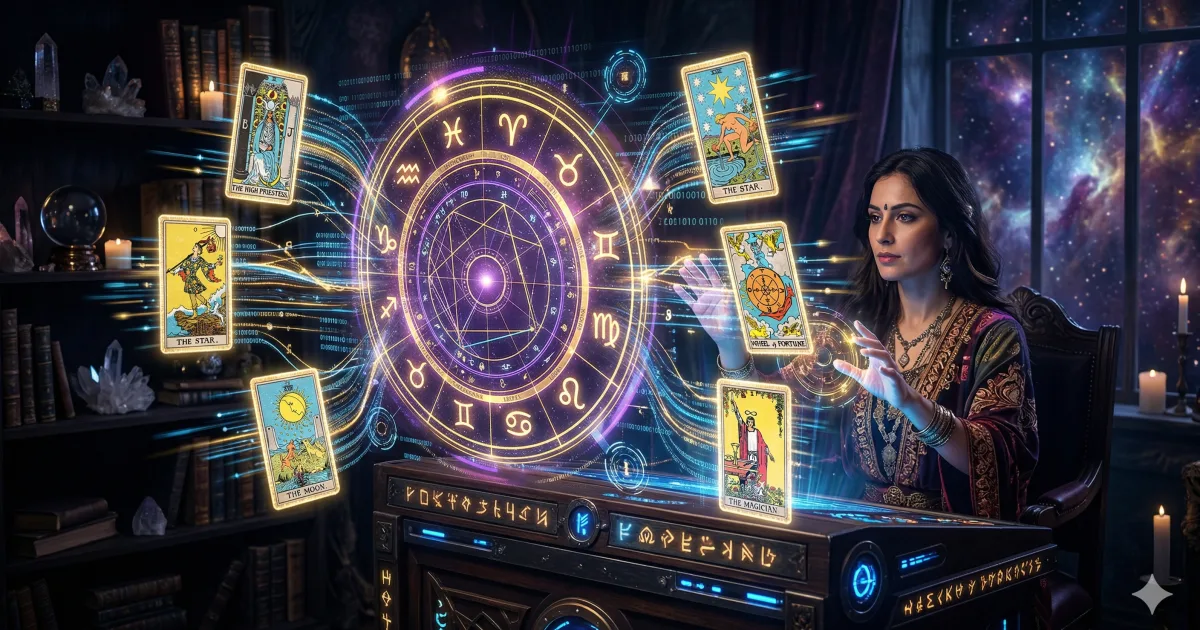
If your horoscope has ever felt too general to be useful — that's not a flaw in you. It's a signal that you're ready for the next layer. In 2026, artificial intelligence is doing something that was impossible even five years ago: taking five separate ancient wisdom systems — Western astrology, Saju (Korean Four Pillars), Zi Wei Dou Shu, tarot, and numerology — and synthesizing them into one personalized reading, built from your exact birth data, in seconds. By the end of this article, you'll know exactly how AI fortune telling is upgrading the practice of divination, which five changes matter most, and one concrete way to use this shift to get guidance that actually applies to your life right now.
- AI can now cross-reference five ancient divination systems simultaneously — something no single human reader can match in real time.
- Saju AI and AI tarot tools have moved past novelty, now delivering depth through pattern analysis across millions of birth charts and card spreads.
- Modern astrology is gaining precision through real-time planetary data — not static sun-sign columns written for one-twelfth of the population at once.
- The biggest shift in technology divination isn't speed — it's personalization at a scale that simply wasn't possible before 2024.
- The most powerful use of AI fortune telling is as a precision tool for self-reflection, not a replacement for your own judgment.
🔮 Get Your Free Multi-Fortune Analysis — 5 Ancient Systems, 1 Unified Reading → MultiForune.xyz
1. Multi-System Synthesis: 5 Systems Read at Once
Here's the structural problem with most fortune readings: they're one-dimensional. Your daily horoscope is based only on your sun sign. Your numerology reading uses only your birth date. Your tarot spread captures only this moment's energy. None of them talk to each other.
The first and most significant way AI is upgrading ancient wisdom in 2026 is multi-system synthesis — the ability to hold five different divination frameworks in memory simultaneously and find where they agree, where they diverge, and what that convergence actually means for your life.
Think of it like getting a second medical opinion — except instead of two doctors, you have five ancient systems that evolved independently across different cultures and centuries. When all five point in the same direction, that signal is far harder to dismiss than any single reading alone.
A human reader who specializes in Western astrology may know Saju in passing. A Saju master may have limited familiarity with Zi Wei Dou Shu. An AI system trained across all five frameworks doesn't have that limitation. It can synthesize a coherent picture from Western astrology, Saju, Zi Wei Dou Shu, tarot, and numerology in the time it takes you to type your birth date.
For you as a reader, this changes everything. Instead of five separate readings that may contradict each other, you get one unified narrative with context: "Your Western chart shows a Venus-ruled 2026. Your Saju pillars confirm a Metal year activating your Day Master's element. Your numerology Personal Year is 6 — the number of home, relationships, and responsibility. Three systems. One theme." That's not coincidence. That's signal.
But the synthesis is only as valuable as the depth behind each individual system — which brings us to where AI is getting genuinely impressive.
2. AI Tarot: From Random Cards to Pattern Recognition
The standard critique of AI tarot has always been this: isn't tarot supposed to be random? Doesn't the meaning come from the mystery of the draw?
Here's what that critique misses. The draw may be random, but the interpretation has never been. Every experienced tarot reader draws on a deep internal library of pattern associations — this card, in this position, in this context, means something specific. The knowledge is the system, not the shuffle.
AI tarot in 2026 is doing something fundamentally different from early chatbot card generators. Instead of generic "the Tower means disruption" explanations, advanced AI tarot tools are now applying three capabilities that change the quality of a reading:
- Contextual interpretation: The same card reads differently depending on what surrounds it, the question asked, and where you are in a life cycle. AI holds that full context without flattening it into a one-line summary.
- Cross-referencing with your astrology: If your natal chart shows a Pluto transit through your 4th house and you draw the Tower in the Home position of your spread, AI can connect those two signals explicitly — not describe each one separately and leave you to make the link.
- Large-scale pattern memory: Across millions of readings, AI systems are identifying which card-position-question combinations tend to correlate with which kinds of themes. This is statistical pattern recognition applied to symbolic language — an edge no single human reader accumulates in one lifetime.
The result isn't a replacement for intuitive reading. It's a depth layer most readers don't have access to. Use it to pressure-test your interpretation, surface an angle you hadn't considered, or begin a line of inquiry your gut already suspects.
Understanding the cards is step one. Here's how technology divination is applying the same depth to the world's most complex birth chart system.
3. Saju AI: Your Korean Four Pillars, Decoded Instantly
Saju — the Korean system of Four Pillars astrology — is one of the most precise birth chart systems ever developed. It maps your life across four pillars (Year, Month, Day, Hour), each containing two characters: a Heavenly Stem and an Earthly Branch. That gives you eight characters total, each with elemental properties, relationships, and interactions that shift across ten-year luck cycles.
The depth is extraordinary. The barrier to entry has always been the same: it requires years of study to interpret with real accuracy, and skilled practitioners have historically been accessible mainly to Korean, Chinese, and diaspora communities where this tradition lives.
Saju AI is dismantling that barrier in 2026. AI-powered Saju tools are now doing something remarkable: not just calculating your pillars, but interpreting the interactions between them — which elements are in conflict, which are in harmony, which ten-year luck cycle you're currently in, and what that means for career, relationships, and wellbeing in concrete terms.
What does this look like in practice? You enter your birth date and time. The AI calculates your Four Pillars, identifies your Day Master element (the core of your personality and life path in Saju), maps your current luck cycle, and interprets which life areas are being activated or challenged specifically in 2026.
For career: if your Day Master is Yang Wood and your current luck cycle introduces strong Metal energy, you're in a classic conflict period — growth meeting resistance. Saju AI doesn't just name the pattern; it explains what that tension typically looks like in practical terms and what kind of action tends to resolve it rather than amplify it.
For relationships: if your Saju shows a specific stem combination that creates an elemental clash with a partner's Day Branch, that's not a condemnation — it's information. AI can explain what that dynamic usually produces, what tends to trigger it, and how people with that pairing have historically navigated it.
This level of Saju interpretation was previously available only to those who either studied for years or had access to an expert reader. That access equation is changing fast.
Saju AI works with your fixed birth data. The next upgrade is about what's moving right now — in real time.
4. Real-Time Cosmic Data: Live Transits, Not Static Columns
Sun-sign horoscopes have one structural flaw that no amount of skilled writing can fix: they're written for one-twelfth of the human population as though everyone in that group is having the same week. The Aries column in a magazine applies equally to someone with Aries rising, Aries moon, Aries sun — and none of those are the same lived experience.
Modern astrology powered by real-time ephemeris data is built differently. Instead of pre-written columns, AI-driven astrology tools pull the actual positions of planets right now and calculate how those transits interact with your specific natal chart — not your sign's chart, yours.
When Jupiter enters Gemini on a specific date, the effect is not the same for everyone. For someone with natal Venus in Gemini in the 7th house, that transit activates relationships and partnership energy in a way that is genuinely distinct from its effect on someone with natal Saturn in Capricorn in the 10th. Real-time transit analysis makes that distinction explicit — and it updates as the sky changes.
Here's what technology divination can do with live data that static columns cannot:
- Identify your personal power windows — specific dates when transiting planets form favorable aspects to your natal chart, activating career momentum, creative output, or relationship breakthroughs specifically for you.
- Flag tension periods before they arrive — when Saturn squares your natal Venus, you can know that 9-month window in advance, not after the fact. The question isn't whether it's happening. It's which direction your relationships are moving because of it.
- Layer solar return data — your chart cast for your birthday this year, combined with ongoing transits, creates a picture that is genuinely year-specific, not recycled from a template.
This is what separates real technology divination from horoscope entertainment. The former uses your actual data against a live sky. The latter uses your birth month against a pre-written paragraph designed to resonate with anyone.
Real-time data makes readings timely. The fifth upgrade makes them truly personal.
5. Hyper-Personalization: When Your Reading Is Actually About You
Here's what most people notice the first time they encounter genuine multi-system AI fortune telling: it feels different from what they expected.
They expected vague. What they got was specific. Not "this is a good year for relationships" — but "your 7th house is activated by Jupiter this year, your Saju shows a Peach Blossom star appearing in your current luck cycle, and your numerology Personal Year 2 is the year most associated with partnership decisions. Three systems. All pointing at the same 18-month window."
Hyper-personalization is the fifth and most transformative upgrade. It works because AI can hold your complete data set — birth date, birth time, birth location, today's date, and the specific question you're asking — and filter every framework through that exact lens simultaneously.
This matters most for the life areas people care about most:
Love & Relationships: Instead of "Scorpio season is intense," your reading identifies which specific houses are activated, whether your Venus-Mars cycle is in a productive phase, and what your Saju Day Branch reveals about your compatibility patterns — not for your sign, for you personally.
Career & Money: Your current Saju luck cycle, your numerology Personal Year, and your progressed chart can all point at the same career inflection point. When they do, that's not coincidence — it's convergence worth acting on.
Health & Wellbeing: Traditional Chinese and Korean systems both contain detailed frameworks for health cycles tied to elemental balance. When your Saju shows a depleted Water element in a Fire-dominant year, that's a signal about stress on the nervous system — specific, not general, and tied directly to your chart.
Key Dates to Watch: Personalized AI readings can generate a calendar of your high-activation dates — not "Mercury retrograde affects everyone" but "Mercury retrograde hits your natal 3rd house ruler, which governs your communication and contracts, specifically between April 15 and May 7." That's the kind of timing most magazine horoscopes never reach.
The five upgrades are real. Here's the one thing to actually do with them.
Your Next Step: How to Use AI Fortune Telling Without Losing the Human Element
One thing worth saying clearly: AI fortune telling at its best is a precision tool for self-reflection, not a replacement for your own judgment or lived experience.
The systems it draws on — Saju, Western astrology, Zi Wei Dou Shu, tarot, numerology — are frameworks for understanding patterns. They surface themes worth examining. They don't override your agency or write your choices for you.
The most effective way to use what's now available is this:
- Start with a multi-system reading for the current year. See which life areas all five systems are pointing toward simultaneously. That convergence is where to focus your attention first.
- Use AI tarot for specific questions, not general guidance. "What is the energy around this decision right now?" produces far more useful output than "what's my future?"
- Check your Saju luck cycle. If you're in a major ten-year shift, that context reframes everything else happening in your life right now — career moves, relationship changes, health signals.
- Look for convergence, not contradiction. When two or three systems point at the same theme, pay attention. When they diverge, hold both interpretations loosely until your lived experience clarifies which is resonant.
- Act on what you find. The point of any fortune reading — ancient or AI-powered — is not to know the future in the abstract. It's to become more deliberate about what you do today.
Ancient wisdom and modern technology agree on this completely: the reading is only as valuable as what you do next.
🔮 Get Your Free Multi-Fortune Analysis — 5 Ancient Systems, 1 Unified Reading → MultiForune.xyz
Frequently Asked Questions
Is AI fortune telling accurate?
AI fortune telling interprets ancient systems — it doesn't claim supernatural prediction. What it does more consistently than most human readers is synthesize multiple frameworks simultaneously and apply them to your exact birth data. Accuracy improves when several independent systems converge on the same theme. Treat it as a precision tool for pattern recognition and self-reflection, not a factual forecast of events.
Can AI really read tarot meaningfully?
AI tarot tools aren't performing intuitive reading in the human sense. What they're doing is applying the symbolic language of tarot — card meanings, positional context, spread relationships — with the added ability to cross-reference your astrological chart and recognize patterns across large datasets. For many people, this produces surprisingly nuanced and practically useful interpretations, especially when combined with astrology and numerology in a unified reading.
How is Saju AI different from Western astrology AI?
Saju and Western astrology are built on different structural foundations. Western astrology maps planets across zodiac signs and houses. Saju maps your birth year, month, day, and hour as a set of elemental characters (Four Pillars) with specific relationships between them. Saju is particularly precise for mapping ten-year luck cycles — major life phases most horoscopes never address. The best AI fortune tools work with both systems, finding where they confirm or complement each other.
What makes technology divination different from a regular horoscope?
A standard horoscope applies one framework (sun signs) to one-twelfth of the population at once. Technology divination uses your specific birth data — date, time, and location — run through multiple frameworks simultaneously, calibrated to today's date. The difference in specificity is significant: a personalized multi-system reading identifies which exact life areas your chart is activating right now, not what's generally true for your sign this month.
Is it safe to enter my birth information into AI fortune tools?
Birth date, birth time, and birth city are the standard inputs — the same information you'd share with any professional astrologer. Use platforms that have clear privacy policies and do not sell personal data to third parties. Reputable multi-system tools, including multifortune.xyz, prioritize user privacy. Always review a platform's data usage policy before submitting personal information.
Keywords: AI & Tools, Modern Astrology, AI Fortune Telling, Saju AI, AI Tarot, Technology Divination